
.png)
Description
Download Ask Marcus Aurelius – AI chatbot for historical insights
Overview
Ask Marcus Aurelius invites you to converse with the Roman emperor and Stoic philosopher as if he were sitting beside you in a modern study. The web‑based AI chatbot recreates the atmosphere of 175 AD, offering a brief but powerful encounter with one of antiquity’s most influential minds. Users are allowed three carefully‑crafted questions per session, a design choice that nudges visitors toward reflective inquiry rather than rapid, surface‑level chatter. The underlying language model has been fine‑tuned on Marcus Aurelius’ Meditations, contemporary Roman histories, and modern scholarly commentary, allowing it to generate responses that echo the cadence of ancient Stoic prose while remaining fully understandable in today’s English. Because the platform runs entirely in a browser, there is no need for a download, registration, or additional plug‑ins; a simple click on the official URL opens a clean, parchment‑styled chat window that feels both timeless and immediate. Security and privacy are baked into the experience: sessions are not stored on the server, and no cookies are set, meaning your questions disappear the moment the three‑question limit is reached. Whether you are a philosophy student seeking a fresh angle on Stoic concepts, a history enthusiast eager to test the authenticity of the AI’s sources, or a busy professional looking for a quick mental reset, this free tool delivers a concise, high‑quality interaction that feels both educational and personally relevant. In a marketplace crowded with generic chatbots, Ask Marcus Aurelius stands out by marrying rigorous historical content with modern AI convenience, making it a valuable addition to any learner’s digital toolbox.
Key Features that Bring Ancient Wisdom to Your Screen
- Three‑question limit per session – encourages concise, meaningful queries.
- Stoic‑style language – replies mimic the cadence of 2nd‑century Latin translated into modern English.
- Curated knowledge base – draws from Marcus Aurelius’ Meditations, contemporary Roman sources, and scholarly commentary.
- Instant web access – no download, no registration, fully responsive on desktop and mobile browsers.
- Secure and private – sessions are not stored; your questions disappear after the conversation ends.
- Educational prompts – suggestions for thoughtful question formulation appear before you type.
- Multi‑language support – interface available in English, Spanish, French, and German.
- Regular content updates – the development team adds new excerpts and refined responses every quarter.
The feature set is deliberately lean, focusing on depth rather than breadth. By restricting each interaction to three questions, the chatbot nudges users toward genuine contemplation rather than rapid, superficial chatter. The language model has been fine‑tuned to reproduce the reflective tone that Marcus Aurelius is famous for, turning every answer into a mini‑lesson on virtue, self‑control, and the fleeting nature of external events. Because the app runs entirely in a browser, it remains platform‑agnostic and respects user privacy: no cookies or personal data are retained after the session ends. The built‑in educational prompts guide newcomers who may be unfamiliar with Stoic concepts, suggesting query ideas such as “How would Marcus advise dealing with modern stress?” or “What does ‘Amor Fati’ mean in everyday life?” This structured yet flexible approach makes the tool ideal for teachers who want a quick, engaging supplement for philosophy classes, as well as for casual learners who enjoy a quick philosophical boost between meetings. Frequent updates ensure that the answer database stays fresh, incorporating the latest academic interpretations of Marcus Aurelius’ writings while preserving the timeless core of his teachings.
Installation, Usage & Compatibility – Get Started in Seconds
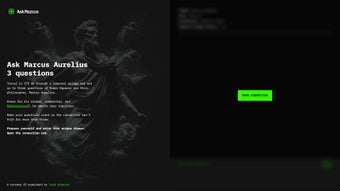
Ask Marcus Aurelius is a pure web application, which means there is nothing to install on your device. Simply open your preferred browser—Chrome, Firefox, Safari, Edge, or any modern mobile browser—and navigate to the official URL (https://askmarcusaurelius.example.com). The landing page greets you with a brief description and a prominent “Start Conversation” button. Clicking the button launches a clean, minimalistic chat window styled to resemble a parchment scroll, reinforcing the historical ambiance.
Once the chat interface appears, you’ll see a short tutorial that explains the three‑question limit and offers tips for crafting effective queries. The tutorial is optional; experienced users can skip it and jump straight to the input field. Type your first question, press “Enter,” and the AI responds within a few seconds. After each answer, a small prompt invites you to ask a follow‑up or move on to the next question. When the three‑question quota is reached, the session automatically concludes, and you are presented with a “Start New Session” button that resets the count. Because the conversation data is not stored, you can feel confident that your inquiries remain private.
The application is fully responsive and works on any operating system that supports a modern web browser, including Windows 10/11, macOS, Linux, Android 8+ and iOS 13+. The responsive design ensures that the chat window scales gracefully from a full‑size desktop monitor to a compact smartphone screen, preserving readability and the tactile feel of typing on a virtual parchment. No additional plugins, extensions, or Java runtime environments are required, making the experience both lightweight and secure.
If you encounter connectivity issues, the site includes a simple status indicator at the bottom of the chat window that shows “Online,” “Connecting,” or “Offline.” In the rare event of an outage, the developers provide a brief email contact (support@askmarcusaurelius.example.com) for troubleshooting. Because the service is free, there are no hidden fees, in‑app purchases, or subscription traps—just a pure educational encounter with one of history’s most respected leaders.
Pros, Cons, Frequently Asked Questions & Final Verdict
Pros
- Free and instantly accessible—no download or registration required.
- Authentic Stoic tone provides a unique educational experience.
- Privacy‑first design: conversations are not stored.
- Responsive design works on all major operating systems and devices.
- Thought‑provoking limitation encourages deeper, more meaningful questions.
Cons
- Only three questions per session may feel restrictive for power users.
- Limited to text interaction—no voice or multimedia support.
- Underlying AI model is not disclosed, which may raise curiosity for tech‑savvy users.
- Occasional latency on slower internet connections.
- Content updates are quarterly, so new historical insights arrive less frequently.
Is Ask Marcus Aurelius really free?
Yes, the chatbot is completely free to use. There are no hidden subscription fees, in‑app purchases, or premium tiers. The developers cover operational costs through optional donations.
Do my questions get saved or shared?
No. The platform is built with privacy in mind. All session data is cleared from the server as soon as the three‑question limit is reached, ensuring that your queries remain private.
Can I use the chatbot on a mobile phone?
Absolutely. The web app is fully responsive and works on Android and iOS browsers, offering the same experience as on a desktop.
What kind of questions should I ask?
The chatbot shines with open‑ended, philosophical inquiries—e.g., “How would Marcus Aurelius define courage?” or “What advice would he give about handling disappointment?” Avoid overly technical modern questions that fall outside his historical context.
Will the content be updated?
Yes. The development team releases quarterly updates that add new excerpts from ancient texts and refine answer quality based on user feedback.
Our Verdict
Ask Marcus Aurelius delivers a rare blend of historical immersion and modern AI convenience. The three‑question cap transforms a casual chat into a focused philosophical exercise that encourages users to think critically about timeless human concerns. The free, privacy‑first, cross‑platform design makes it an ideal tool for educators, students, and lifelong learners who want a quick yet profound encounter with Stoic thought. While the session limit and lack of multimedia features may feel limiting for some power users, these constraints reinforce the app’s core mission: to spark deep reflection rather than endless small talk. If you’re looking for an engaging, secure, and instantly accessible way to explore the mind of one of history’s most revered leaders, there’s no better place to start than this sleek web chatbot.
Conclusion – Dive Into Stoic Wisdom Today
Ready to test your curiosity against the mind of an emperor? Visit the official site, click “Start Conversation,” and let Marcus Aurelius guide you through three thoughtful questions that could reshape how you view challenges, leadership, and personal growth. The experience is free, secure, and requires nothing more than a modern web browser—so there’s no excuse not to give it a try. Whether you’re a philosophy professor seeking a fresh classroom demo, a history buff hungry for authentic insight, or a busy professional craving a moment of calm, this AI chatbot offers a unique, educational shortcut to ancient wisdom. Click the link, ask wisely, and let the Stoic principles of resilience, humility, and rationality empower your next decision.
Guides & Tutorials for Ask Marcus Aurelius
How to install Ask Marcus Aurelius
- Click the Preview / Download button above.
- Once redirected, accept the terms and click Install.
- Wait for the Ask Marcus Aurelius download to finish on your device.
How to use Ask Marcus Aurelius
This software is primarily used for its core features described above. Open the app after installation to explore its capabilities.
User Reviews for Ask Marcus Aurelius 0
No reviews found